

Sub-Total: $0.00
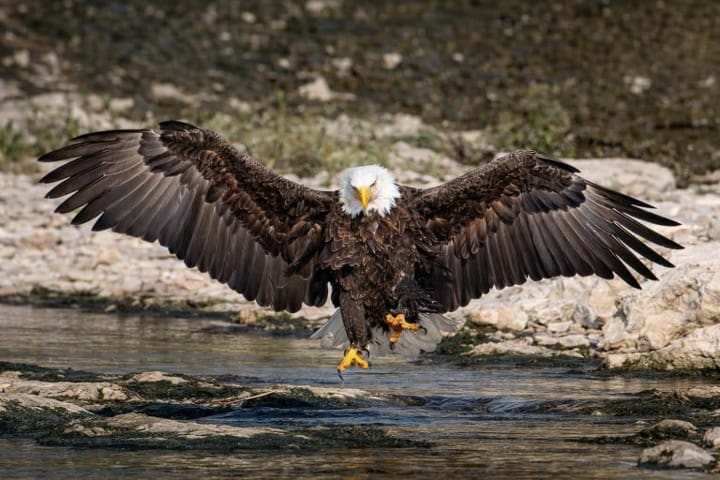
The Eagle Has Risen: America’s Greatest Conservation Story Turns 250
There’s a moment that never gets old.
You’re standing at the edge of a Texas lake — maybe Texoma, maybe Caddo, maybe the Sam Rayburn Reservoir in the deep pine woods of East Texas — and something large moves along the tree line. The wingbeat is slow, deliberate, almost lazy. Then the white head catches the light, and the white tail glints as the bird banks over the water. Your chest does something. It doesn’t matter how many times you’ve seen it. It’s emotional.
That is an American Bald Eagle. And the fact that you can stand anywhere in the United States in 2026 and have a reasonable chance of seeing one is nothing short of a miracle.
In the 1960s, it almost didn’t happen.
The Brink
By the mid-20th century, the bird that Benjamin Franklin famously argued against as the national symbol — in favor of the turkey, which he considered more respectable — had been reduced to a shadow of its former self. Why?
DDT. That’s the short answer. Dichlorodiphenyltrichloroethane. A synthetic pesticide introduced after World War II that was hailed as a near-miracle of modern agriculture. It was sprayed across farmland, wetlands, and waterways throughout the United States. And it worked its way up the food chain with devastating efficiency. As a child in Iowa, I remember the town being sprayed by plane with DDT for mosquito control. It was common for the neighborhood kids and I to run out under the mist. Little did we know. And as we know, Bald Eagles eat fish. Fish concentrate DDT in their tissues. When eagles ate the fish, the DDT disrupted calcium metabolism in the birds’ bodies, causing them to produce eggshells so thin that the weight of a nesting parent would crush them. Reproductive failure on a continental scale resulted. Sadly, generation after generation of empty nests.
So by the early 1960s, fewer than 450 nesting pairs of Bald Eagles survived in the lower 48 states. The bird that had graced the Great Seal of the United States since 1782 — the bird that meant freedom, strength, and wildness — was disappearing.
The Turn
Two decisions changed everything.
The first was scientific. In 1962, Rachel Carson published Silent Spring, a landmark work of environmental writing that drew a direct line between pesticide use and the collapse of bird populations across North America. The book was controversial, fiercely opposed by the chemical industry, and absolutely right. It planted a seed that would eventually become a movement.
The second was legislative. On December 31, 1972, the Environmental Protection Agency banned the domestic use of DDT. It was one of the most consequential environmental decisions in American history, and its effects would not be fully understood for decades.
Then came the Endangered Species Act of 1973 — signed by President Nixon — one of the most powerful wildlife protection laws ever enacted. The Bald Eagle was formally listed as Endangered in the lower 48 states in 1978. It received the full weight of federal protection.
And slowly, steadily, beautifully, the eagle began to come back.
The Recovery
Conservation recovery stories don’t usually move fast. Nature has its own timeline. But the Bald Eagle’s comeback has been one of the most dramatic reversals in the history of wildlife management.
From fewer than 450 nesting pairs in the 1960s, the population climbed:
1974: ~800 nesting pairs
1984: ~2,000 nesting pairs
1994: ~4,400 nesting pairs (downlisted from Endangered to Threatened in 1995)
2007: over 10,000 nesting pairs — enough to declare the mission accomplished
On June 28, 2007, the U.S. Fish & Wildlife Service announced the removal of the Bald Eagle from the Federal List of Endangered and Threatened Species. The official delisting date was August 8, 2007. After decades of legal protection, habitat preservation, banning of the primary pesticide threat, and tireless work by wildlife managers and conservationists, America’s national bird was officially recovered.
But the story doesn’t end there.
The delisting triggered a 20-year post-monitoring period — a commitment to watch and document the population’s continued health and ensure the recovery holds. That monitoring period concludes in August 2027.
And the numbers? By the time of the most recent comprehensive survey, Bald Eagle populations had reached approximately 71,400 nesting pairs and an estimated 316,700 individual birds across the lower 48 states. That’s not recovery. That’s a triumphant return. That’s worth celebrating!
Eagles in Texas.
Texas occupies a unique place in the Bald Eagle’s story.
For most Texas birders, the eagle is a winter bird — arriving from northern breeding grounds in October and departing by March, congregating around the large lakes and reservoirs that dot the state. Lake Texoma north of Dallas. Caddo Lake in the Piney Woods of East Texas. Lake O’ the Pines. Sam Rayburn Reservoir. Toledo Bend. The Highland Lakes chain along the Colorado River. The lower Trinity River corridor. These are reliable Texas eagle haunts — places where, on a cold January morning, you might count a dozen or more birds working the shoreline or perched in bare-limbed trees watching the water below.
But Texas has also become a year-round eagle state. Nesting territories — now numbering well over 150 known pairs and growing — stretch from the reservoirs of East Texas through the Hill Country and into the river systems of Central Texas. The Guadalupe River. The Frio. The Nueces. And for me, I monitor a nest on the San Gabriel River outside of Taylor. It’s apparent that many pairs that once wintered here have stayed, found mates, built nests, and raised young. What was once a seasonal visitor in many parts of the state is increasingly a resident.
To see a Bald Eagle over a Texas lake is to see America’s conservation promise kept.
Today America Turns 250
This year, the United States celebrates its 250th birthday. On July 4, 2026, the nation marks a quarter millennium of existence — a moment for reflection, for pride, and for honest reckoning with both the heights and the failures of American history.
The Bald Eagle has been the symbol of this nation since 1782 — adopted by the Founding Fathers as an emblem of freedom, power, and independence. And in 2026, for perhaps the first time in many generations, the symbol and the reality are in genuine alignment.
There are more Bald Eagles in the lower 48 states today than at any point in recorded history. More than there were when the first Congress met. More than there was before European colonization reshaped the continent’s waterways and forests. More than almost, anyone dared to imagine when 450 pairs clung to survival in the 1960s.
That is not a small thing. That is America at its best — recognizing a catastrophic mistake, summoning the political will and scientific knowledge to correct it, and staying the course long enough to see the results.
What It Means
Here’s what I want you to take from this story.
Conservation works. Not always. Not quickly. Not without cost. But when good science, strong law, sustained commitment, and public support align — as they did for the Bald Eagle — the results can be extraordinary.
The Bald Eagle didn’t recover because the problem solved itself. It recovered because people decided it mattered. Farmers adjusted their practices. Lawmakers passed legislation. Wildlife managers counted nests and tracked populations for decades. Organizations fought to maintain protections even when economic pressures pushed back. Ordinary Americans looked at the idea of losing their national symbol and said: not acceptable.
As we head toward the end of the post-delisting monitoring period in August 2027, the data is clear. The recovery is real and it is holding.
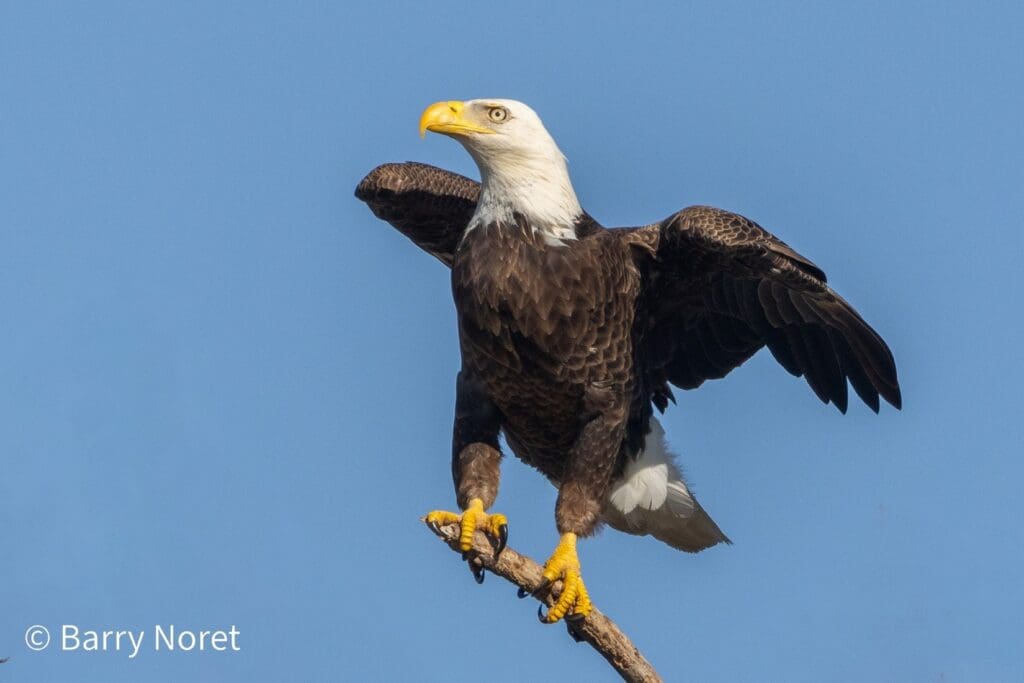
And the next time you’re standing at the edge of a Texas lake and that slow, heavy wingbeat moves along the tree line — that white head turning toward the water, that effortless glide on seven feet of wingspan — I hope you feel what I feel. Gratitude. Awe. And a quiet, unshakeable pride that this bird is still here.
Happy 250th, America. The eagle is flying! Barry Noret, Birds of Texas.com
Special thanks and credit to Laurie Blankenship-Lawler for allowing me to use her amazing American Bald Eagle as the feature photo for this article!